Deciding whether to repair or completely replace a compromised support system is one of the most critical choices a property owner can face. While minor settling can often be fixed with simple piers, severe structural breakdown requires a complete rebuild to safeguard the building’s future.
Understanding when a home has crossed the line from manageable repair to total replacement prevents wasted money on temporary fixes. Recognizing the major signs of structural failure ensures you take the right steps to secure your investment long term.
Extreme Concrete Spalling and Structural Disintegration
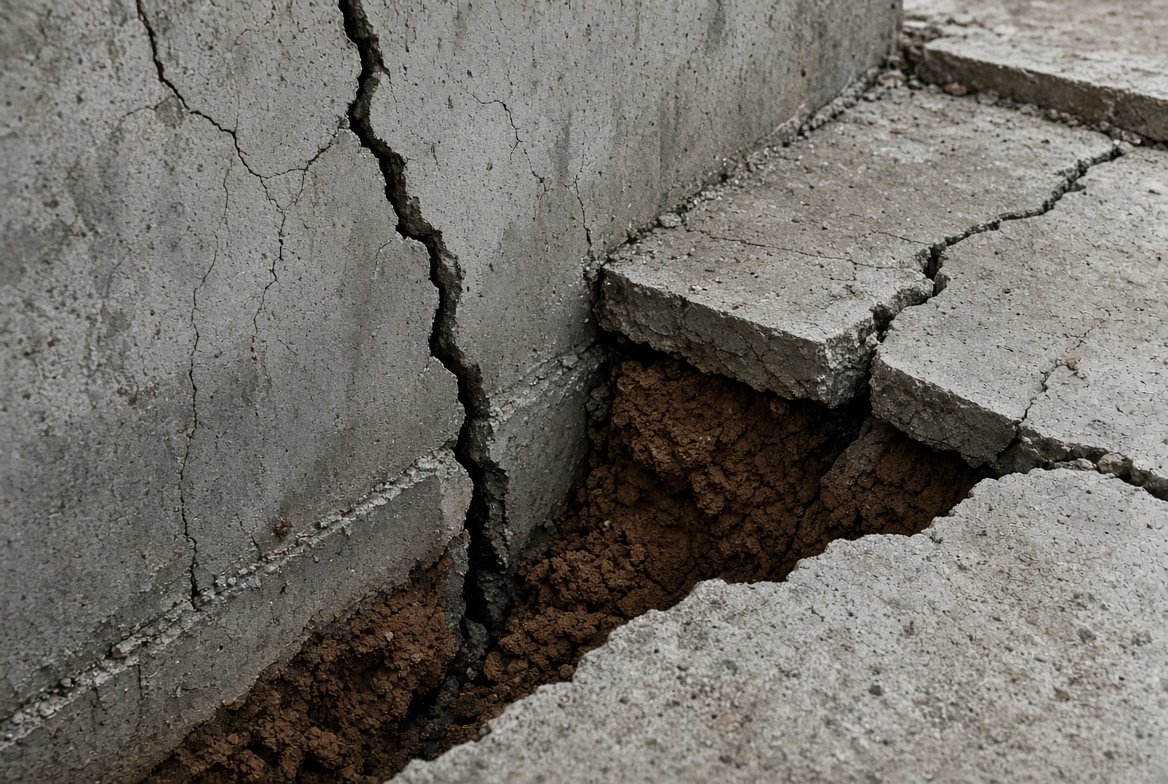
When concrete undergoes severe decay due to age, chemical exposure, or continuous water saturation, it loses its fundamental load-bearing strength. Surface crumbling eventually turns into deep structural disintegration, making standard patching techniques ineffective for long-term safety.
When concrete suffers total chemical or physical breakdown throughout its core structure, minor stabilization methods can no longer hold the load. A complete tear-out and pour provides a fresh, high-strength concrete base that guarantees decades of reliable support.
- Large chunks of concrete flaking, crumbling, or breaking away from exterior foundation walls
- Deep horizontal fractures exposing rusted internal steel reinforcement rebar to open air
- Soft, flaking concrete surfaces that crumble easily when scraped with a simple hand tool
- Extensive hollow pockets forming deep within poured concrete slabs or support footings
Severe Soil Heaving and Massive Wall Bowing
Hydrostatic pressure caused by expansive soils pushing against basement or stem walls can exert thousands of pounds of force. When support walls bow inward beyond a safe limit or fracture severely, structural integrity is lost and partial fixes become unsafe.
Extremely bowed or sheared masonry walls are at immediate risk of sudden collapse under heavy weather or soil conditions. Replacing the entire wall structure restores complete lateral stability and eliminates structural collapse hazards.
- Inward wall deflection or bowing that measures several inches off true plumb line
- Long, horizontal cracks running continuously through the center of basement walls
- Shearing along the bottom course of concrete blocks where walls meet the floor slab
- Exterior walls leaning noticeably outward away from upper floor framing members
Widespread Fire, Chemical, or Environmental Damage
Catastrophic events like major house fires or severe chemical spills can permanently alter the molecular integrity of concrete and steel footings. Intense heat causes concrete to crack, spall, and lose structural density even if the surface appears mostly intact.
When environmental hazards compromise the core strength of an entire pad, spot repairs fail to bring the system up to modern building standards. Complete replacement allows engineers to install modern, rebar-reinforced footings designed for environmental resilience.
- Discoloration, charring, and extensive heat-fracturing across concrete surfaces after a fire
- Chemical contamination that breaks down binding agents inside the concrete mixture
- Severe frost heave damage that shatters uninsulated shallow footings across large areas
- Major earthquake or flood events that completely shatter load-bearing concrete footings
Compromised Load-Bearing Alignment Across the Entire Footing
Severe land slumping or major sinkhole activity can drop one side of a property significantly out of level. If a structure has settled unevenly across every section, attempting to lift individual corners often tears the remaining frame apart.
Lifting a severely distorted building onto localized piers can cause irreparable framing damage and internal stress. Demolishing the failing slab and repouring a properly engineered grid foundation levels the entire house cleanly and permanently.
- Differential settlement across multiple corners exceeding several inches from center
- Severe twisting or warping in floor joists and load-bearing wall studs throughout the home
- Structural weight shifting entirely onto interior partition walls that lack subfloor footings
- Repeated failed repair attempts where piers continue to sink into unstable deep soil layers
Extensive Structural Failure in Historical or Unreinforced Masonry
Older homes built on unreinforced brick, fieldstone, or sub-standard mortar often reach a point where the original support materials simply decay completely. Attempting to anchor modern steel piers into crumbling historical mortar usually causes the old masonry to shatter under pressure.
Historical foundations lacking modern engineering simply cannot handle the stresses of contemporary lifting and piering equipment. Replacing unreinforced stone or brick with a modern steel-reinforced concrete foundation protects the architectural history above.
- Mortar between historical fieldstones or soft brick footings crumbling into sand
- Total absence of steel rebar reinforcement throughout historical concrete structures
- Footings poured directly onto shallow topsoil layers without proper depth or footing pads
- Continuous shifting in soft stone footings that cannot support modern home additions
Investing in Total Structural Peace of Mind
Choosing a full foundation replacement provides a clean slate that guarantees safety, energy efficiency, and long-term property durability. While a complete rebuild requires a significant commitment, it permanently solves deep-seated structural issues that simple repairs cannot fix.
A modern, professionally installed support structure restores full market value and guarantees your home remains stable for generations. Consulting with structural experts ensures you choose the safest, most effective path forward for your home.